
Born in Warsaw in 1933. A graduate of the J. Zamojski High School in Lublin, winner of the 2nd National Mathematical Olympiad, he completed his mathematics studies at Maria Curie-Skłodowska University in Lublin in 1955; he also earned his doctorate there five years later. His supervisor was one of the founders of the Lublin mathematics center, Prof. Dr. hab. Adam Bielecki, his mentor and later friend. In this way, Prof. Kisyński became part of a genealogical line of outstanding mathematicians. Adam Bielecki was a doctoral student of Witold Wilkosz, a doctoral student of Stanisław Zaremba, a doctoral student of Gaston Darboux, a doctoral student of Michel Chasles, a doctoral student of Simeon Poisson, a doctoral student of Joseph Lagrange, a doctoral student of Leonhard Euler, a doctoral student of Johann Bernoulli, and a doctoral student of Jacob Bernoulli, who was a doctoral student of Gottfried Leibnitz.
Jan Kisyński's early scientific interests bore the mark of his teacher, who worked, among other things, on differential equations, and were very well received by the mathematical community. However, the breakthrough experience was the lecture by Prof. Dr. Hab. W. Mlak, who came to Lublin to talk about a new field: differential equations in Banach spaces. This led Jan Kisyński to begin a systematic study of Hille and Phillips's fundamental monograph on operator semigroups. In 1959, the young scientist moved to Warsaw, where he worked at the University of Warsaw and the Institute of Mathematics of the Polish Academy of Sciences. During this time, he was greatly influenced by Professor Krzysztof Maurin and the seminar on differential equations led by Professor Bogdan Bojarski. Collaboration with Professor Maurin led Jan Kisyński to write a series of papers on the generation of tight measures – today, these papers form an integral part of the canon of mathematical measure theory.
His results in the theory of operator semigroups also soon became widely known. Green's work on operators is cited extensively in the second edition of K. Yosida's now classic monograph and in S. G. Krein's monograph, and his proof of the Trotter-Kato theorem, still astonishing in its ingenuity, is repeated almost word for word in almost all books on semigroups. In the early 1970s, Jan Kisyński published a series of articles devoted to the connections between semigroup operators and the so-called operator cosine functions, the theory of which was then in its infancy. Today, these works are considered fundamental worldwide. Once again, the Professor's work has become a classic of mathematics.
Among the achievements of this period, also worthy of special attention is Marek Kac's proof of the probabilistic formula for solving the telegraph equation, perhaps not as fundamental, but still astonishing in its beauty and elegance. The key idea in this proof is the analysis of a certain noncommutative, locally compact abstract group. In 1976, lectures on semigroups of operators, delivered by Jan Kisyński at the International Centre for Theoretical Physics in Trieste, were published. His scientific achievements were crowned with a habilitation (1964), an associate professorship (1973), and a full professorship (1983). Since the early 1980s, the Professor's research has focused on Markov processes. His papers are published on the probabilistic interpretation of Lévy and Wentzl integral kernels, Wentzl boundary conditions, the local time that processes spend on the boundary of state spaces, topology in Skorochod space, and other related topics. The professor uses advanced analytical methods to construct appropriate semigroups of operators, proving that the common belief that stochastic methods reach further than analytical ones is not entirely justified. Meanwhile, in 1985, he returned to Lublin and, together with Professors A. Lasota and K. Burdzy, organized a seminar. From that time until 2004, when he retired, he worked at the Lublin University of Technology as Head of the Department of Mathematics.
In 1991, the professor was elected a corresponding member of the Polish Academy of Sciences. No other mathematician from Lublin has ever received this exceptional honor, and all the members of the Polish Academy of Sciences in Lublin, living and deceased, can be counted on the fingers of one hand. (Mieczysław Biernacki, the long-time head of the Department of Mathematics after the war, was a member of the Polish Academy of Arts and Sciences before the war.) The Professor's interest in representations of convolution algebras and semigroup-distributions dates back to around the mid-1990s. Among other things, he presents a beautiful algebraic version of the Hille-Yosida theorem, showing in particular the connections between the theory of semigroups of operators and factorization theorems of the Cohen type. He writes papers on the Fourier transforms of semigroup-distributions and proves that the classical correctness condition given by Pietrowski is in fact a condition for generating a semigroup.
Despite his approaching ninetieth birthday, the professor continues to prove profound theorems and publish in international journals. There is no doubt that his latest works, now not widely known because they require profound analytical knowledge, will soon become canonical. He has received numerous awards for his scientific achievements: he has received, among others, the Polish Mathematical Society Award for Young Mathematicians and the S. Mazurkiewicz Award of the Polish Mathematical Society, twice the First Degree Award from the Ministry of Science and Higher Education, the Award of the Third Department of the Polish Academy of Sciences, and three times the Award of the Scientific Secretary of the Polish Academy of Sciences. He has been awarded the Knight's Cross of Polonia Restituta, the Gold Cross of Merit, the Medal of the 40th Anniversary of the People's Republic of Poland, and the Medal of the National Education Commission. Since June 20, 2009, Professor Kisyński has been a corresponding member of the Polish Academy of Arts and Sciences. Many associate the professor's name with functional analysis and operator semigroups. But his most striking characteristic is his interest in many, very diverse branches of mathematics. He himself admits: "When forced to characterize my interests, I say I am a functional analyst," but he understands functional analysis broadly, in a modern way, as a natural generalization or offshoot of classical analysis. Even a cursory glance at his bibliography reveals an extraordinary range of interests: semigroups of operators, differential and partial equations, measure theory, general topology, Fourier analysis, etc. And in all of these areas, the Professor has significant achievements!
He is an extraordinary mathematical erudite, a rare case in times of far-reaching specialization. He has reviewed well over 100 doctoral dissertations, habilitation theses, and professorial applications in various fields of mathematics. He is widely known for understanding and feeling many issues he claims to be unfamiliar with better than many specialists. It is no wonder that in his works he so masterfully combines results from various fields. An outstanding analyst, gifted with an extraordinary ability to get to the heart of the matter. His works delight with their fresh perspective and elegance, even an asceticism of words, a skill bestowed on few by the use of paper and pen. And the Professor is like his works. And this is what gives him such a profound influence on his students. His extraordinary personality, profound knowledge, accuracy, and enthusiasm for understanding and applying mathematics, for discovering the essence of a problem and expressing it precisely and analytically, constitute an inexhaustible source of inspiration for them. Of his nine doctoral students, five have habilitated, and three have obtained the title of professor.
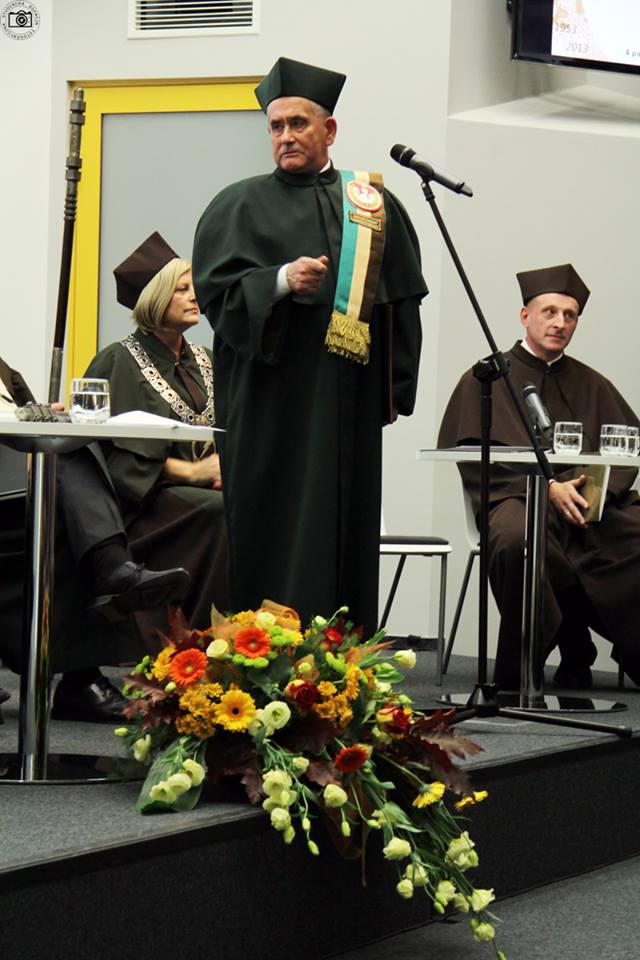
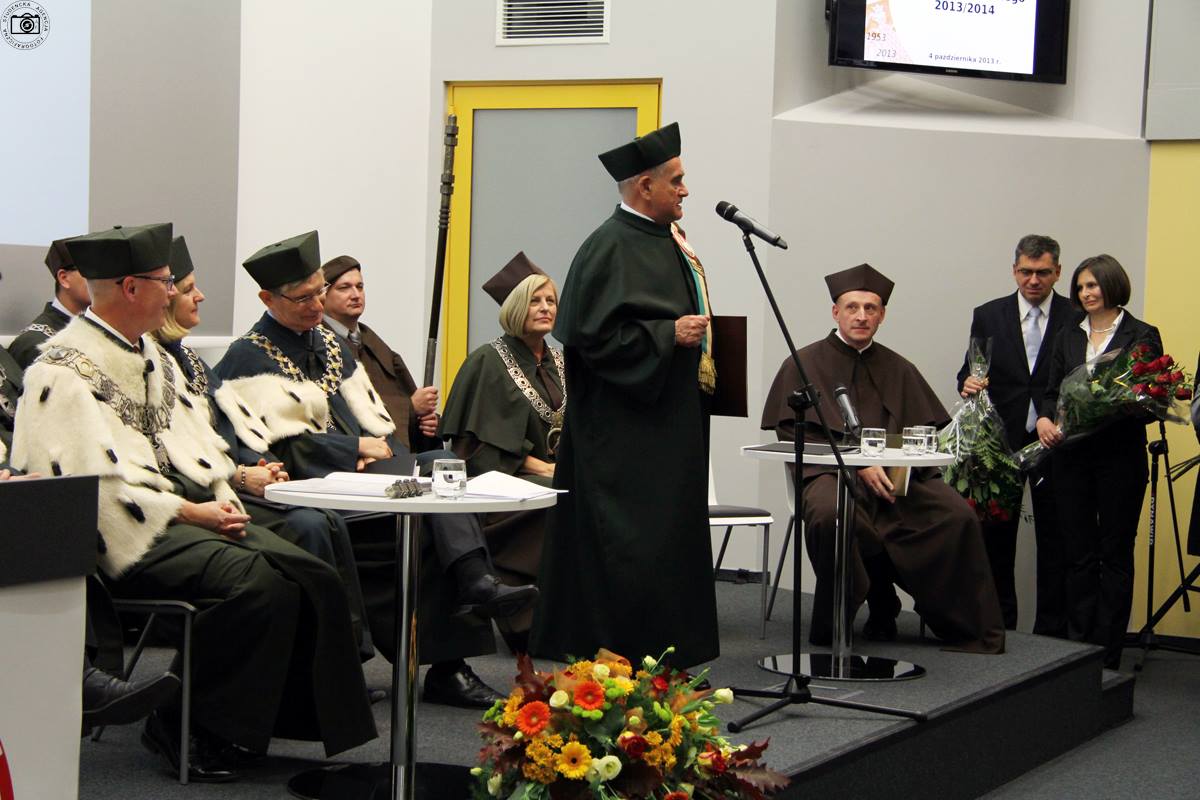
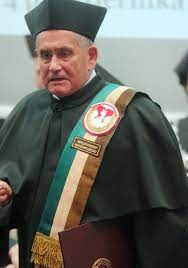
The ceremony of awarding the title of Honorary Professor of the Lublin University of Technology to Prof. Dr. hab. Jan Maria Kisyński for outstanding scientific achievements, achievements in staff development and promoting the university through his membership and activity in international, national and regional bodies took place on 4 October 2013 in the Aula of the Eastern Innovative Centre of Architecture.

Projekt współfinansowany ze środków Unii Europejskiej w ramach Europejskiego Funduszu Społecznego, Program Operacyjny Wiedza Edukacja Rozwój 2014-2020 "PL2022 - Zintegrowany Program Rozwoju Politechniki Lubelskiej" POWR.03.05.00-00-Z036/17